


Stop Guessing with Your Second Largest Expense: The Data-Driven Era of Space Planning
For most enterprise organizations, real estate is the second largest line item on the P&L, trailing only payroll. Yet, while companies track payroll to the penny, they often manage their real estate portfolios with best guesses and outdated spreadsheets.
In a hybrid world, this lack of precision is expensive. Industry benchmarks suggest that up to 40% of assigned office space sits empty on any given workday. With the average cost of an unused desk hovering around $10,000–$20,000 annually in major markets, the "cost of waste" for a 5,000-person enterprise is staggering.
The problem isn't a lack of space; it’s a lack of intelligence. Traditional space planning suffers from three critical failures:
- Bad Attendance Data: Relying on manual "bed checks" (walking floors with a clipboard) or swipe data that doesn't accurately reflect everyone who walks through the doors (hard without turnstiles).
- Decision Latency: By the time you aggregate quarterly data into a spreadsheet, the usage patterns have already changed.
- The "Headcount Trap": Planning based on who is employed rather than who attends.
Calven has built a modern, AI-driven Operating System for workplace teams to solve this. Here is how we turn the chaotic mess of hybrid data into an elegant, efficient space strategy.
Step 1: Unified Intelligence
You cannot manage what you cannot measure. Calven moves beyond simple badge swipes by ingesting data from multiple sources - WiFi logs, sensor data, booking software, HRIS feeds, and yes - badges - to create a unified model of attendance.
Crucially, we solve the problem of Attribution. It is not enough to know that the 4th floor is busy; you need to know who is making it busy. Calven attributes usage to specific departments and cost centers.
- Is Engineering overflowing on Tuesdays?
- Is Sales strictly remote on Fridays?
- Is Finance utilizing 90% of their assigned neighborhood while Marketing utilizes 30%?
This granular visibility allows you to bill back costs accurately and identify specific teams that need more (or less) space.
Step 2: The Modern Stack Plan
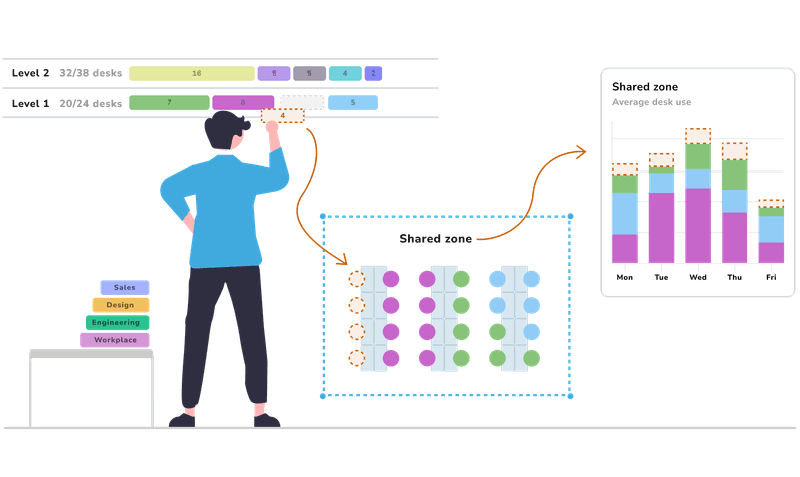
Spreadsheets are where space strategies go to die. Our dynamic Stack Planning view gives you a digital cutaway of your building, visualizing density in real-time.
We separate the data into two critical views that often tell contradictory stories:
- Headcount (The "On-Paper" View): Where employees are assigned.
- Attendance (The "In-Reality" View): Where employees actually sit.
This reveals the "Ghost Town Effect"—floors that are technically fully allocated but physically empty. You can instantly spot opportunities to consolidate floors or sublease space without impacting employee experience.
Step 3: Algorithmic Stacking (Let AI Do the Heavy Lifting)
Manual blocking and stacking is a game of Tetris that no human can win perfectly. You have hundreds of constraints: "Sales needs to be near the client center," "Legal needs private offices," "Product needs 20% growth capacity."
Calven’s AI Auto-Allocation replaces manual shuffling.
- Predictive Modeling: Our "Prediction Metric" analyzes historical attendance trends and seasonality to forecast exactly how much space a team will need next quarter - not based on what they say they need, but based on how they actually behave.
- Constraint-Based Optimization: You set the rules (e.g., "Keep Product and Design together"), and our algorithm runs thousands of permutations to find the most efficient layout that maximizes density while preserving team adjacencies.
Step 4: Scenario Planning & Stakeholder Alignment
In the current economic climate, agility is the ultimate asset. You may need to plan for a 20% headcount reduction or a sudden acquisition.
Calven’s Scenario Builder allows you to create "Digital Twins" of your office. You can run unlimited "What-If" scenarios without moving a single chair:
- Scenario A: What if we close the satellite office and move everyone to HQ?
- Scenario B: What if we switch Engineering to a 3:2 desk-sharing ratio?
This solves the political friction of space planning. You can share these visual scenarios with Department Heads, allowing them to validate the plan before execution. This turns an adversarial conversation ("You're taking my space!") into a collaborative data-driven discussion.
Step 5: The "Closed Loop" Execution
The biggest failure point in traditional planning is execution - the gap between the plan on the screen and the reality on the ground.
Because Calven is also the employee-facing booking app, your plan is actionable instantly. When you publish a new layout:
- Desk permissions automatically update.
- Team neighborhoods are digitally reassigned.
- The digital map in your employees hands is automatically updated.
There is no need to manually update a separate CAFM system or print out new floor maps. The strategy becomes reality immediately.
Ready to Right-Size Your Real Estate?
In a world where the office is an ecosystem, not a container, static planning is a liability. Move from reactive firefighting to proactive optimization.
Check out more space planning details at https://www.calven.com/features/space-planning, or contact Calven for a live demo to see how you can optimize your workplace!


Ready to reimagine your future of work?
See how Calven can help you shape better work experiences for everyone: